
Home / Podium
Entries, waves, categories, live results and prize giving — running in the cloud while the event is still on the course.
Built around our hardware · no lock-in · your data stays yours
Then why ours
There is a lot of scoring software out there and most of it is good at what it does. All of it can take a read off our hardware — that is what an open system means. What none of it can do is everything the box is capable of.
We write the firmware and we write Podium, so the two ship together. Claim a box to your account, send it commands, correct its clock — from the cloud, without walking back out to the timing point.
Other scoring software receives reads. It cannot reach back into the box, because it was never given a way to.
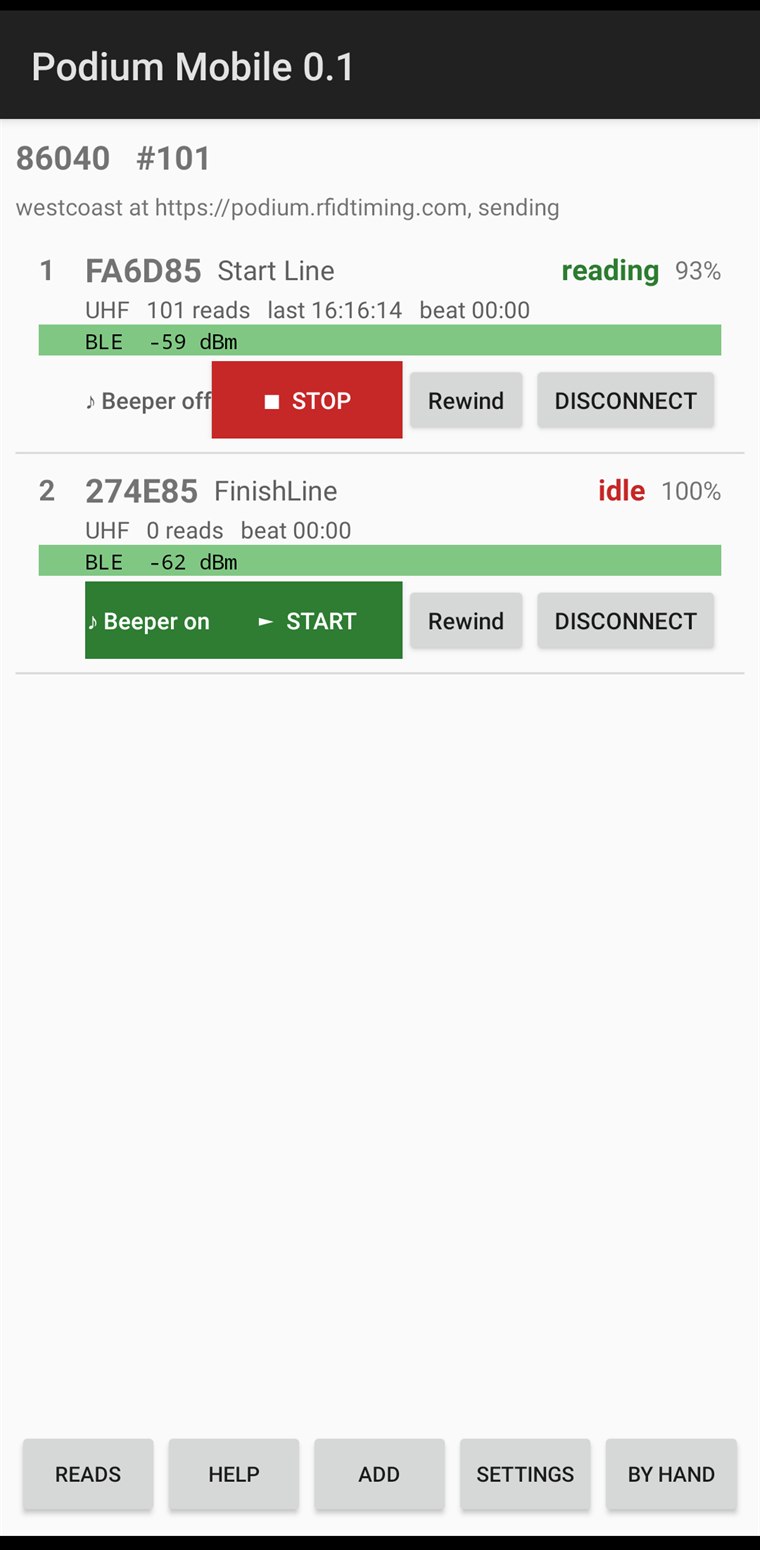
Scoring software usually expects a network socket. Podium Mobile connects straight to a box over Bluetooth — no dongle, no laptop, no network at all — and Podium PC does the same through the dongle.
It is the difference between a timing point that needs infrastructure and one that needs a phone in your pocket.
A read becomes a result
Two real races, replayed from their own chip crossings. The reads land on the left and the result on the right is worked out from them — the box, the link out, the scoring, the public page. The replay runs them close together so you can see the order of it.
At the timing point
0 reads at the line
Public results, updating
Why it was built
The expensive part of timing an event was never the hardware. It is who has to stand at each timing point, and how good they have to be.
A point that needs a laptop needs somebody who can work the laptop — and somebody who can rescue it when it stops.
No laptop, no software, nothing to decide. Set it down, switch it on, check the screen says it is reading. That is a job you can hand to a marshal or a casual — it does not need a timer.
The box keeps reading and holds up to 125,000 reads whether anything is listening or not, then catches up by itself when the signal comes back. Nobody out on the course has to notice, and nobody has to drive out to them.
Every deployed box reports into one event. One experienced person scores it — from the truck, from the finish tent, or from an office a thousand kilometres away.
That is the constraint worth naming. A contract timer can only take on as many events as they have people who can be trusted with a timing point. Everything above is aimed at that one number.
The boxes feed whatever software you already run, and that is not changing — it is your data and your choice. Scoring centrally across boxes somebody else deployed is simply the thing Podium was built to do.
Three ways in
All three talk to the same event. The timing truck and the marshal out on the split are looking at the same data, at the same moment.
Web · any browser
PodiumThe event itself. Set it up, take entries, score it, publish it.
Windows
Podium PCThe application in the timing truck, for the person watching the reads arrive.
Android
Podium MobileFor out on the course, where there is no desk and no laptop.
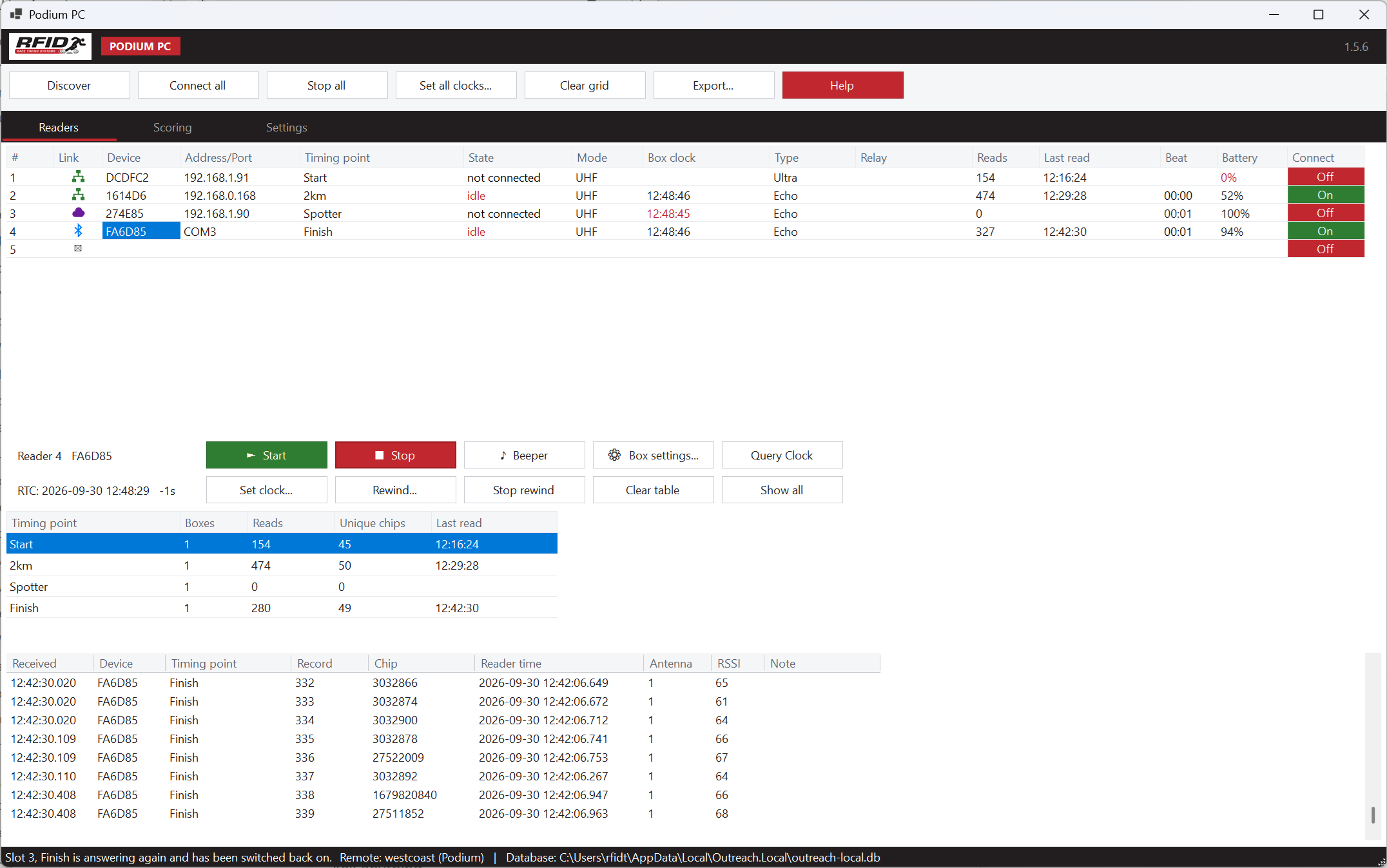
Swipe across the screenshot →
Race day
Build the event — races, waves, categories. Open entries and take the money, or import a list you already have. Entrants need no account.
Boxes come up and report in. You can see every timing point from the truck or from a phone on the far side of the course.
Reads arrive and are scored as they land. The public results page updates itself while people are still running.
Category places and prize giving are already worked out. Results stay published, and the times are frozen so they cannot drift later.
What it costs
Not usage tiers you have to watch. Pick the one that describes you.
A club
per year
A contract timer
priced per timer
Time one event this year or fifty. The number above does not move.
A twenty-person club handicap costs the same to score as a sell-out marathon: nothing on top of the licence.
Online entries are free to take. Only a paying entrant carries $1, and it comes out of the payment, not out of your pocket.
We make no margin on the tags you use — ours or anybody else's. The licence is the whole of what we charge.
*Excludes local taxes and duties. Add 10% GST for Australian customers. Prices in Australian dollars.
The part nobody asks about until it matters
Podium reads our boxes, and our boxes work without Podium. Leaving costs you nothing but the effort of leaving.
The open system →Raw reads stay visible, not just the tidy result. If a time looks wrong you can see exactly what the hardware recorded.
How results are built →The whole help corpus is public, whether you are a customer or not. Read how it works before you decide anything.
Read the help →There is a 30 day free trial. Ask for it and we will send you an invite — a real account with your own event in it, not a demo with somebody else's data.