Home / Systems / EchoActive Plus

EchoActive Plus

The whole timing point in one sealed case. Disposable UHF chips and reusable active transponders, read by the same box, at the same time, on the same clock.

The current base unit · designed, built and supported in Perth · 2 year warranty · firmware free for life

Why one box reads both

Two technologies, two jobs

UHF and active are not competing answers to the same question. They are good at different things, and most timers end up wanting both — which until now meant two systems, two clocks and two sets of results to reconcile.

UHF · passive chip

When the entry list is long

A printed chip with no battery, powered by the antenna as the entrant crosses. Cheap enough to go in the bib and never come back.

  • Chips from around 20c on the open market, bought from anyone you like
  • Four antenna ports on the box, detected automatically — plug one in and it is used
  • Nothing to collect, count, chase or re-issue after the event
  • Any compliant chip from any supplier. We do not code ours to lock you in
  • Region-set at the box: FCC, EU, Australia, China, Japan, Korea and 15 more

Disposable · from 20c on the open market† · no collection

Active · 2.4 GHz transponder

When the result matters

A battery-powered transponder that is woken by a 125 kHz loop under the mat and answers with its own timestamp, taken from the box's clock.

  • 5 ms precision, and the transponder is synced to the base within 100 microseconds
  • 80 transponders per second through the point
  • Reads at up to 110 km/h — cycling, motocross, skiing
  • Carries up to 40 of its own reads, so a transponder that passes an unattended point still hands over its times later
  • Waterproof to 10 m, so swim legs are not a special case

Reusable · $55 each · six year battery
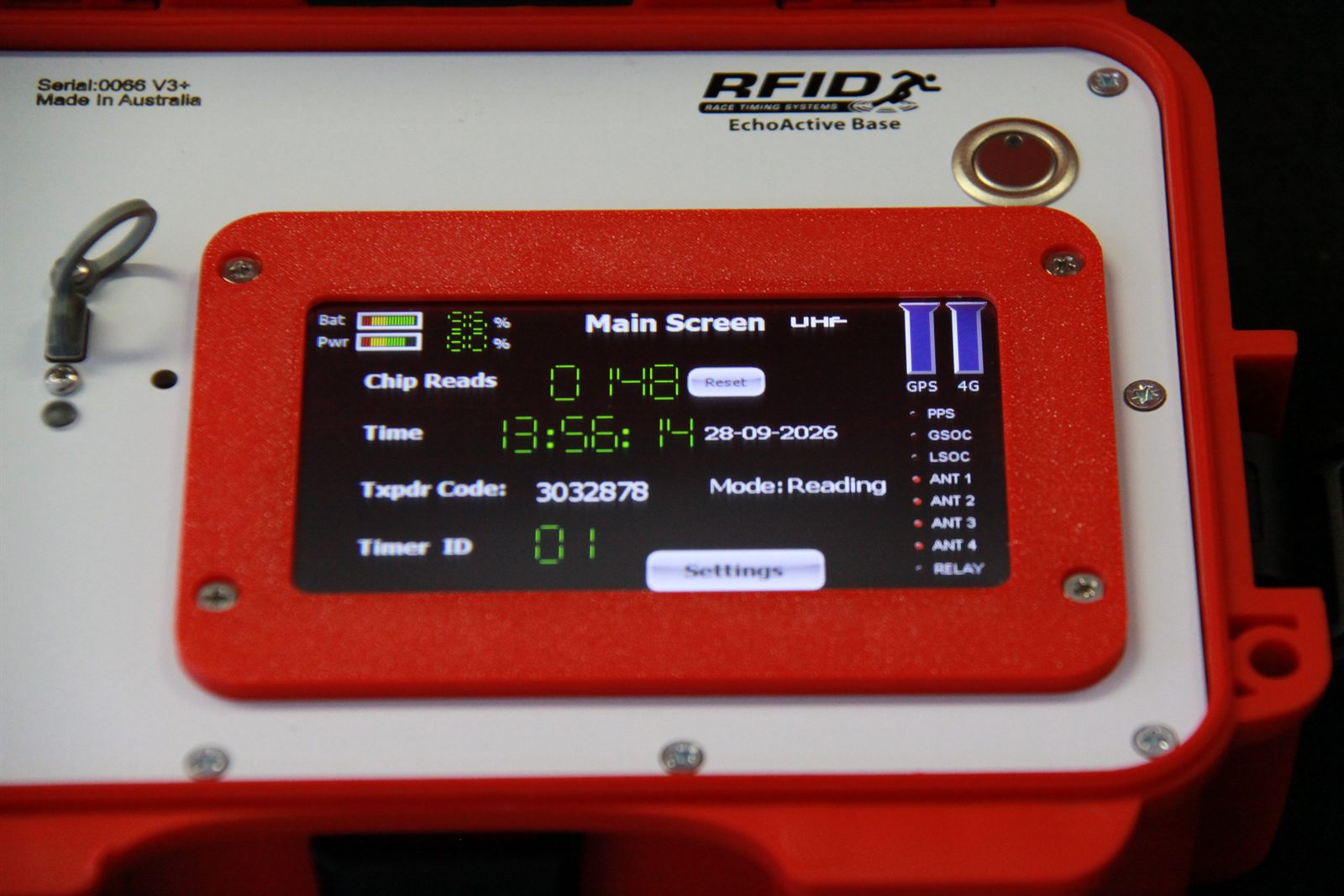
The EchoActive Plus screen mid-race: 148 chip reads, mode reading, GPS and 4G connected, all four antennas live
Mid-race, on the box itself. The count, the clock, the last transponder seen, and a lamp for each of the four antennas — so a dead antenna is something you can see at the point rather than something you work out from the results afterwards.
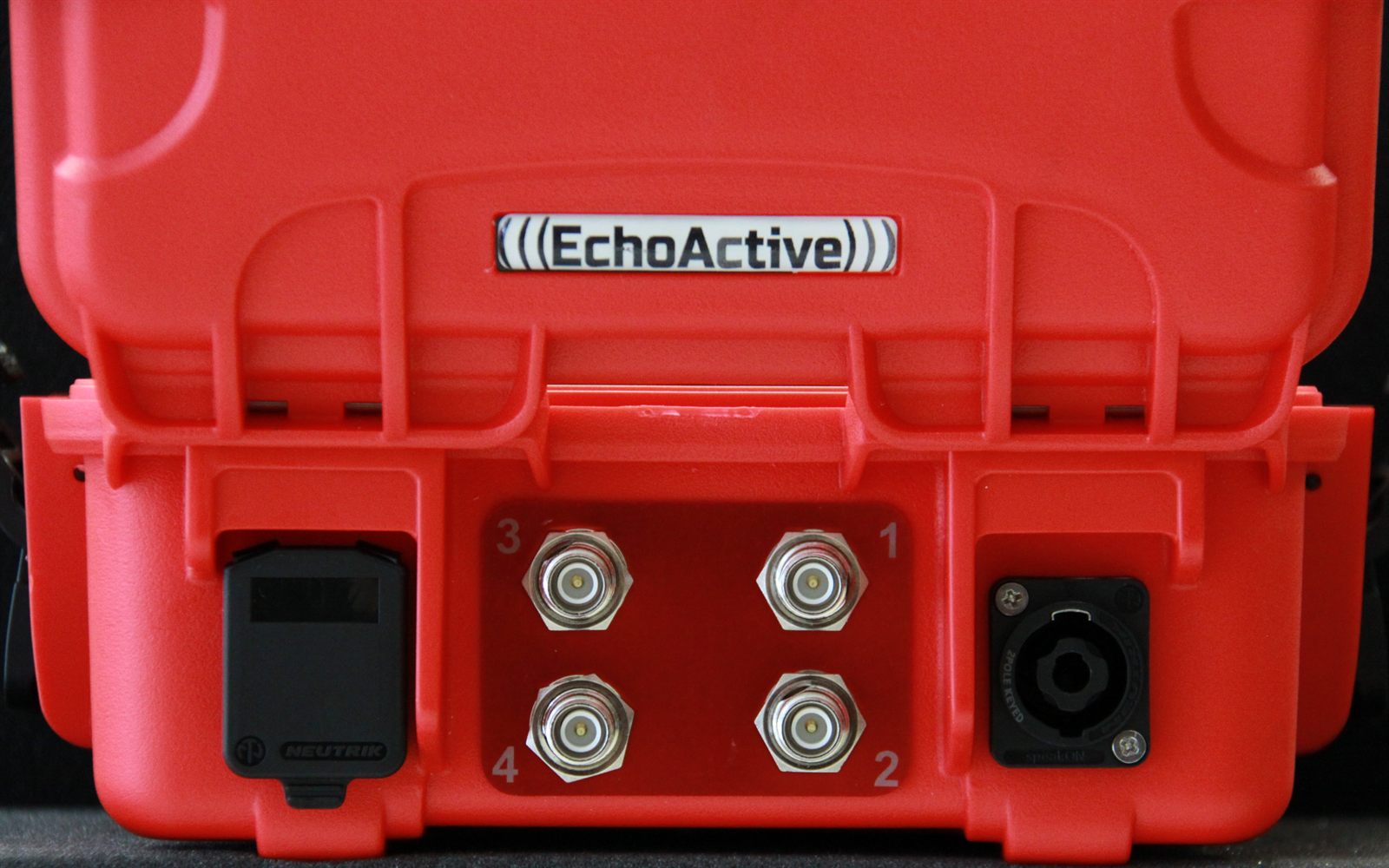
The four numbered UHF antenna outputs on an EchoActive Plus, beside the ethernet and power connectors
These four outputs are what make it a Plus. Every EchoActive carries the same badge; the UHF antenna ports are the difference. Ethernet and power sit beside them, both locking connectors.

Both run at once on the same box, on one clock, into one set of results. A club can put chips in the bibs for the fun run and transponders on the elite wave, and never think about which is which again. †High volume, unencoded or printed.

On the ground

What a timing point actually is

One case, opened on the ground or on a table, and whatever the point needs plugged into the back of it.

The box

Opens, wakes, finds its clock and starts reading. The touchscreen tells you what it is doing without a laptop attached to it.

The loop or the antennas

A trigger loop from 3 to 12 metres long for active transponders, and up to four UHF antennas for passive chips. Run either, or both.

Power

75 watt-hours on board, with a second battery as an option and USB-C to charge it.

The link out

Ethernet on DHCP or a static address, an optional 4G modem, or nothing at all — the box holds 125,000 reads on its own and gives them up when something asks.
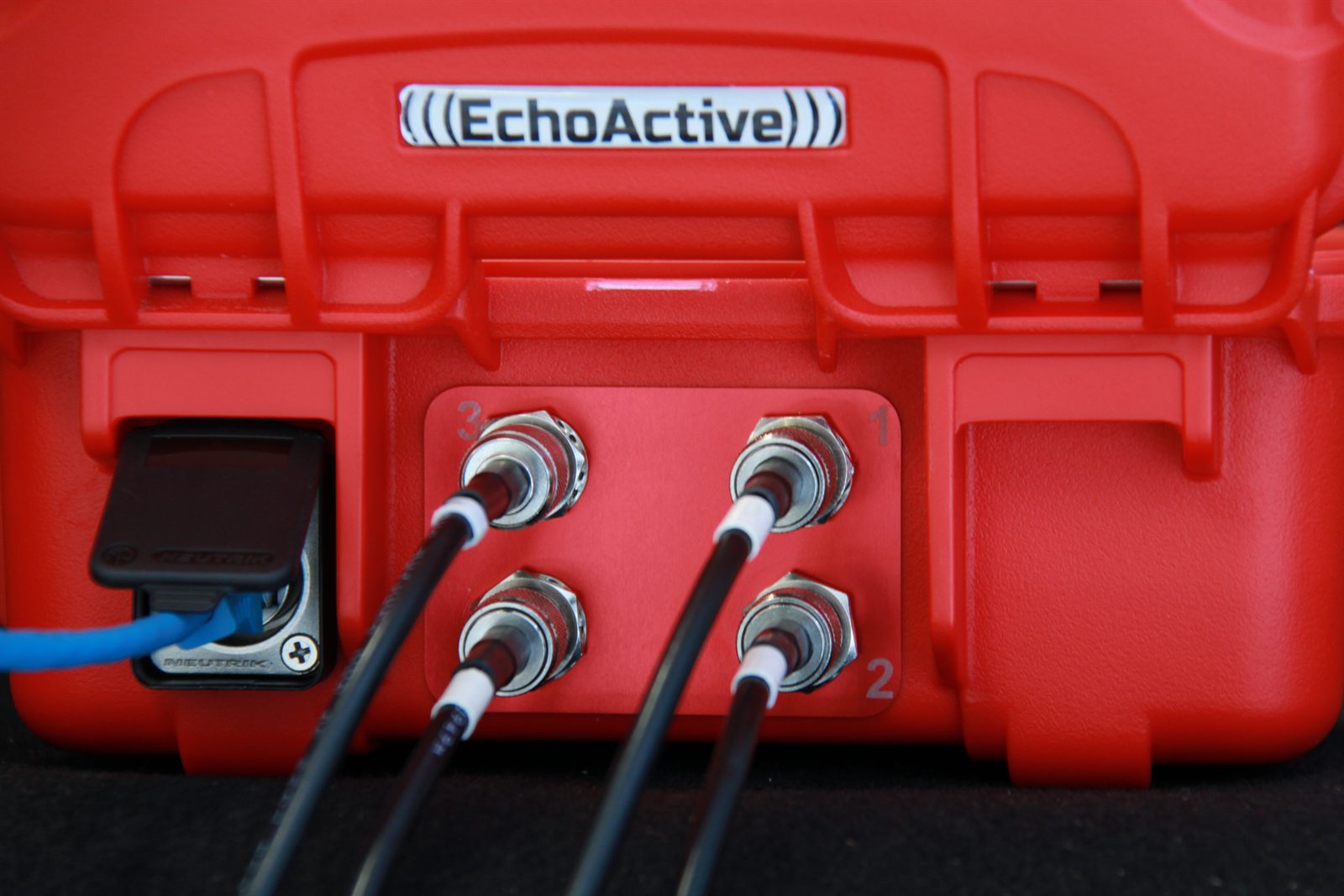
Four UHF antenna cables and an ethernet lead plugged into the back of an EchoActive Plus
A built point, from the back: four antennas and the ethernet lead. Every connector locks — nothing here is held in by friction and a hope that nobody trips over it.
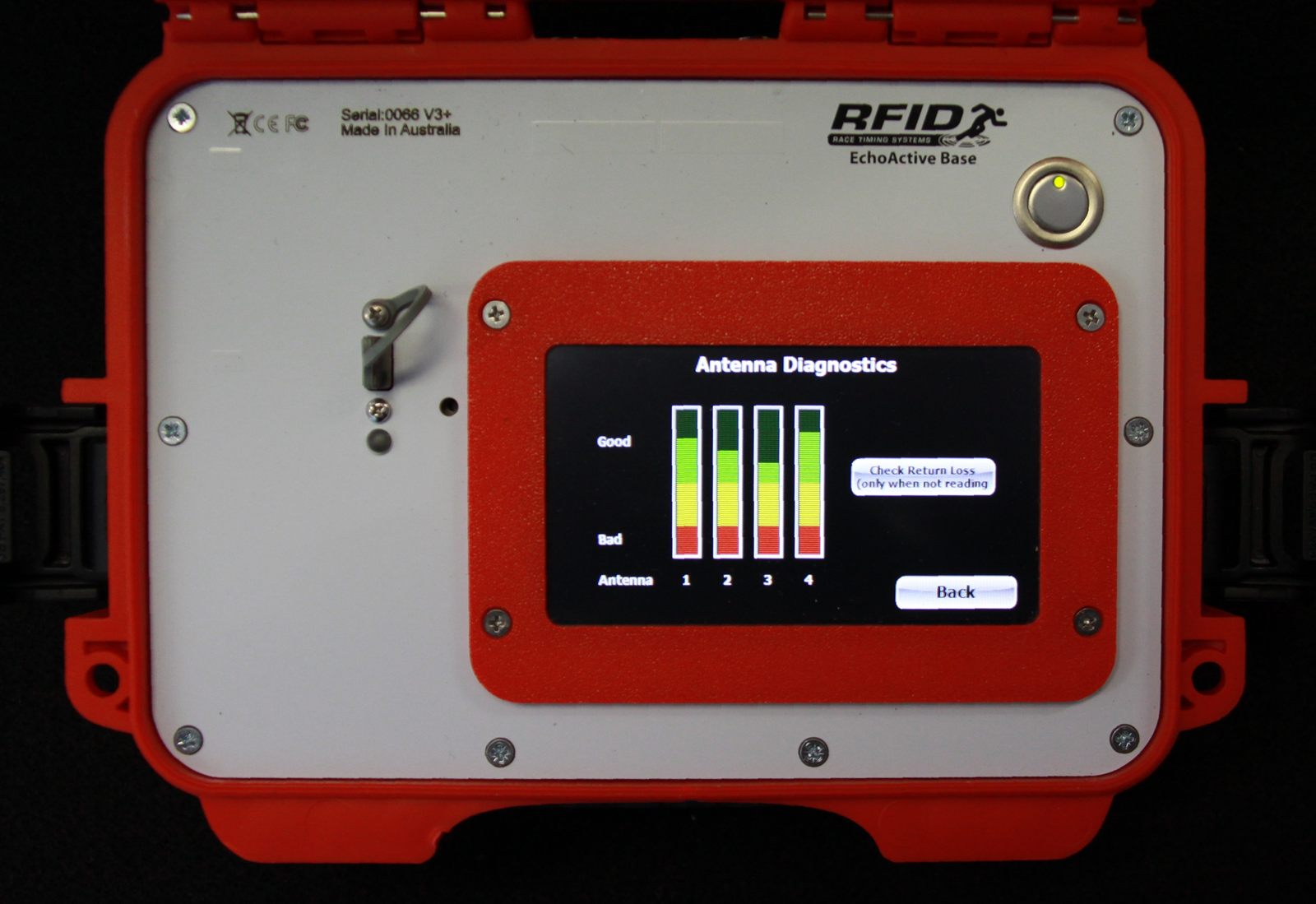
The antenna diagnostics screen showing a return-loss bar for each of the four antennas
And the box will check its own antennas. Each one gets a bar from bad to good, read before the race rather than guessed at — a cable crushed in transit shows here, not in a gap in your results.

If you already run a reader and a laptop

Why not just a reader and a laptop?

It works. An industrial off-the-shelf UHF reader, a laptop, software stamping the chip codes as they arrive — people time real events that way every weekend, for a fraction of what any built system costs, and there is a lot to be said for knowing your own kit that well.

None of what follows shows up on a good day. It shows up on the morning something completely ordinary happens: the network drops, someone kicks a cable, a battery goes flat with forty minutes still out on course.

The ordinary thingA reader and a laptopEchoActive Plus
Power Mains or a generator, and two things to feed. The timing point stops when either the reader or the laptop stops. 75 Wh on board. A second battery is an option, and USB-C charges it. Nothing to plug into at the timing point.
The link drops mid-race A switch reboots, a cable gets kicked, the laptop picks that moment to install an update. Reads only ever existed in the software's memory, so the ones that arrive while nothing is listening never existed at all. There is nothing to go back to. 125,000 reads held in the box. It keeps reading and keeps them whether anything is listening or not, then hands the lot over when something asks again. A dropped link costs you nothing.
The clock is the laptop's The time recorded is the time the read reached the software — after the reader's buffer, the USB stack and whatever else the machine was busy with. That delay is not constant, which is what makes it hard to correct afterwards. Timed at the line, not at the laptop. A temperature-compensated 5 ppm clock set from GPS, and transponders that carry their own timestamps synced to the base within 100 microseconds. The box also times the strongest read of a crossing rather than the first one it hears — the first read can be metres short of the line.
Somebody has to sit with it A laptop needs a table, shelter, power and a person. On a split three kilometres out that is a real cost — and a screen nobody can read in the sun. It runs on its own. An 880-nit touchscreen on the box tells you what it is doing, sealed to IP67 with the lid shut, and it works from −25 °C to +50 °C. Put it down and walk away.

None of this makes the cheaper way wrong. It is how a lot of very good timers started, and for a dry club event on a table under a gazebo it is genuinely fine.

The part worth sitting with is who pays when it is not. Someone got up at five, drove an hour and ran the race. If the reads covering their four minutes through the arch are gone, then so is their time — and they will not care whether it was the switch, the laptop or the cable. They will remember who timed it.

That is the only argument we would make for a purpose-built box, and it is usually why people come looking for one. If you are reading this after a morning like that, you probably already know which row above bit you — the guided quote will tell you what it costs to not have another, in about two minutes and without sending anybody an email.

Your data, your route

Where the reads go is your decision

The box does not care what scores the event. It hands over reads, and you point them wherever you already point them.

Your own software

Racetec, your own code, or anything else that speaks the protocol, over the network or the USB-C port. The protocol is documented and it is not going to change under you.

Works with what you already time on
Podium

Reads travel over 4G to the cloud, get scored as they arrive, and land on a public results page while the race is still running.

Optional — new
Nothing, for now

No network at the point? The box keeps 125,000 reads and hands the lot over when it next sees something. A dropped link costs you nothing.

Buffered on board
You are not locked into Podium. This box hands its reads to whatever scoring software you run, and has never depended on ours — that is the whole point of an open system. You will need scoring software of some kind, though. Every timer pays for some.

The numbers

Full specifications

Published figures for the base unit, the transponder it reads, and the Nano that covers the points a full base unit does not need to go to.

UHF

The passive side, and what most events use.

Antenna ports
Four, connection detected automatically — plug one in and it is used
Chips
Any compliant UHF chip, from any supplier. Ours are not coded to our readers
Regions
Set at the box: FCC, EU, Australia, China, Japan, Korea and 15 more
Reading
Ground mats across the crossing, or side antennas where the line is narrow

Active

Fitted to the same box. Leave it off and the unit is $3,300.

Read rate
80 transponders per second
Precision
5 ms, with transponders synced to the base within 100 µs
Capture speed
Up to 110 km/h
Frequency
125 kHz wake-up, 2.4 GHz BLE
Trigger loop
3–12 m long, 0.3–0.8 m wide — no mats at any width up to 12 m

Both

One box, so everything here is true either way.

Clock
Temperature-compensated crystal, 5 ppm (±0.432 s per day), set from GPS
Read gating
4 seconds
Memory
125,000 records in flash
Battery
3.7 V, 75 Wh Li-ion. Second battery optional, USB-C charging
Charge time
3–4 hours
Screen
Capacitive touch LCD, 880 nits
USB
USB-C PD, max 12 V 1.5 A (18 W)
Connectivity
Ethernet, DHCP or static IP. Optional Quectel 4G LTE modem
Which read is timed
A chip is seen many times as it crosses, across all four antennas. The box keeps the timestamp of the strongest read rather than the first one it happened to hear — the moment the chip was closest to the antenna, which is the line itself
Weight & size
1.15 kg · 231 × 173 × 97 mm
Temperature
−25 °C to +50 °C
Sealing
IP67 lid closed, IP65 lid open
Warranty
2 years. Firmware updates free for the life of the product

Bluetooth

On every box, at no extra cost. Three separate jobs, and what makes the link safe to rely on.

Bluetooth
Bluetooth Low Energy, on every box. Three separate jobs — to a USB dongle on a PC, straight to an Android device, and box-to-box on one timing point. How each one works →
To a PC
A USB dongle carries more than one box on a single PC link, each identified by its ethernet MAC. No cable to the timing point and no network to set up
To Android
A phone or tablet talks to a box directly over BLE — no dongle, no laptop and no venue network
Box to box
Several boxes cover one timing point — one master and the rest relaying their reads to it, which merges them and sends one stream out over ethernet. No switch and no second power supply in the field. UHF mode
Box-to-box radio
BLE Coded PHY, the long-range mode, for the distance across a wide crossing
Frames authenticated
Every relayed frame carries an HMAC-SHA256 tag, so a box outside your group cannot feed reads into your timing point
Each box keeps its own log
A relayed box logs independently and can be asked to replay it, so a read is recoverable even if the link was down when it happened
If the link drops
Reads are held on the box and caught up automatically when it comes back, on a cursor and acknowledgement the same as the 4G path

Timing mats

Sold as
A 4 m system, not by the section — one system covers 4 m of crossing
What reads them
The box's UHF antenna ports. One box drives 4 m of mats
A wider crossing
One system per 4 m, and a box for every 4 m with it. An 8 m finish is two systems and two boxes
A second row
Large fields get a row behind the first as a backup read. It fills the boxes' remaining ports, so it costs mats and not boxes
Chips it reads
Any passive UHF chip — ours, or whatever you already buy
Price
$2,300 per 4 m system*

Mats are how a passive UHF crossing gets read from the ground, and for most running events they are not optional — the width of the line decides how many, and that is most of what a timing point costs. The alternative is side antennas, which are far cheaper but only suit a narrow crossing; active transponders need no mats at all.

Transponder

Precision
5 milliseconds
Time source
Synced from the base, within ±100 microseconds
Capture speed
Up to 110 km/h
Wake-up
3 axis, 3 channel, 125 kHz ASK
Frequency
2.4 GHz BLE
Memory
Up to 40 records, overwritten automatically after 72 hours
Battery
3.0 V CR2032, 220 mAh
Battery life
Guaranteed 6 years, expected 8
Bluetooth mode
1 second periodic advertisement, 1 second precision
Weight & size
15 g · 39 × 32 × 12 mm
Waterproofing
To 10 m depth
Construction
UV-stable impact-resistant polycarbonate, epoxy encapsulated
Firmware
Updated over the air

The six year guarantee assumes under 3,000 reads and under 100 hours in Bluetooth mode a year; the transponder counts both itself. After that it is pro-rata — a failure at four years discounts the replacement by a third.

Nano

Timekeeping
Mobile network and/or GPS
Frequency
2.4 GHz BLE
Sensitivity
−95 dBm minimum
Read gating
Variable, 10–45 seconds
Memory
3,000 records in flash
Battery
3.7 V, 16.5 Wh Li-ion. Minimum 24 hours
Charge time
3 hours
USB
USB-C, 5 V 1 A, with COM port
Modem
Quectel 4G LTE
Weight & size
300 g · 40 × 47 × 80 mm
Sealing
IP65
Warranty
1 year
Firmware
Updated over the air

The Nano reads active transponders only. It is the answer to a split point up a hill, a lap counter, or a second line you did not plan for.

Figures as published in the EchoActive technical sheet. Both the 4G modems are upgradeable to 5G.

Around the box

What else the point takes

Side antenna

UHF antenna for the side of the course, on a stand or a barrier. Up to four to a box.

$575 AUD*
Antenna cable

Low-loss cable between the antenna and the box.

$145 AUD*
Transponders

Reusable active transponders. Buy them once, use them for years.

$55 AUD each*
UHF chips & tags

Disposable chips on foam for bibs, multisport tags and neoprene ankle bands. Buy disposables wherever you like — the open market starts around 20c and most contract timers source their own. Which one your event wants →

85c AUD encoded & printed†

*Excludes local taxes and duties. Add 10% GST for Australian customers. Today's shop prices. EchoActive Plus is $4,950. If you will never read a UHF chip — road cycling, BMX and motocross generally will not — the same box without the UHF reader fitted is $3,300. †Open-market chips start around 20c for a plain inlay you encode and print yourself, and you are free to buy them from anybody — nothing in the box cares whose chip it is. Ours are 85c: the chip on a 3 mm foam spacer that holds it clear of the athlete so the read is not lost, encoded to your race numbers and printed — 85c at any quantity up to 2,000 and 80c above it, with no minimum order.

After you own it

Nothing behind a login

Manuals and firmware are open to anybody, customer or not. You should be able to read how a box works before you buy one, and you should be able to fix one on a Sunday.

Tell us about your event

How many entrants, what sport, how many points, and what you already use to score it. We will tell you what you need and what it costs — including if the answer is that you do not need anything new.