
Three things can cross your timing point: a printed chip on a race bib, a reusable tag on an ankle strap, or a battery transponder. They are not three grades of the same product. Two of them are passive UHF and one is active, and which you want is decided by your event, not by the box.
Every EchoActive Plus reads all three · nothing here is locked to us
Start here
Almost every enquiry lands on one of these. Find the line that sounds like your event and the choice is already made.
A large run
A chip on the bibDisposable UHF, printed with the race number and stuck to the back of the bib. It goes home with the entrant and you never think about it again.
Why: an open-entry field leaves with whatever is on them. Reuse is not available at any price, so the cheap disposable is the only sensible answer.
A club
A reusable tagPassive UHF on an ankle strap, handed out at the start and collected at the finish. The same tags come back out of the box next month.
Why: the same faces every month. Nothing to re-order, nothing to encode, and no per-event consumable to forget. This is not the active transponder — a club wanting reusable does not have to jump to an active system.
Small field, fast moving, many timing points
An active transponderA battery transponder on an ankle strap, or cable-tied to a bike or a machine. It carries its own timestamp and it comes back at the end of the day.
Why: speed and repeat crossings are where passive gives up. Road cycling, triathlon and motocross are the sports the manual names for it.
The difference underneath
One has a battery in it and one does not, and every difference in price, read rate and what happens after the finish line follows from that single fact.
Passive · UHF Gen 2
A printed aerial on a sticker or in a moulded tag. It sits dead until it passes through the antenna's field, borrows just enough energy from it to answer, and goes quiet again.
From 20c disposable · $12.90 reusable
Active · 2.4 GHz transponder
Woken by a 125 kHz loop laid on the ground, it answers with a timestamp it took itself, synced to the box. It is not waiting to be powered, so speed and angle stop mattering.
$55 each · collected and used again
The range
One disposable, one reusable, one active. There used to be four disposables at four prices, which helped nobody choose.
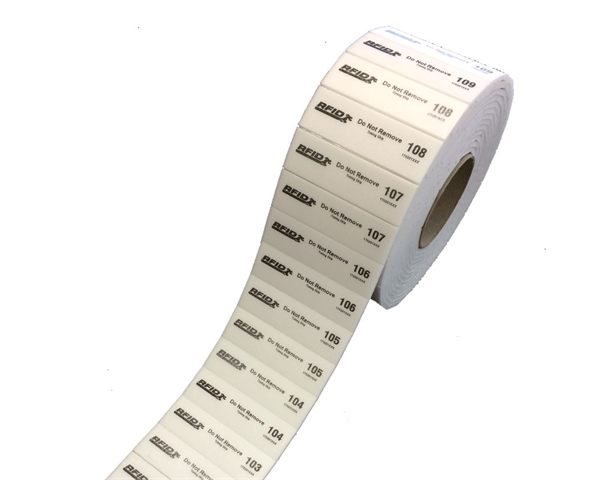
Passive UHF · disposable
Our disposable chip, and the only one we sell. The foam spacer holds the aerial clear of the athlete, because a body is mostly water and water kills the read.
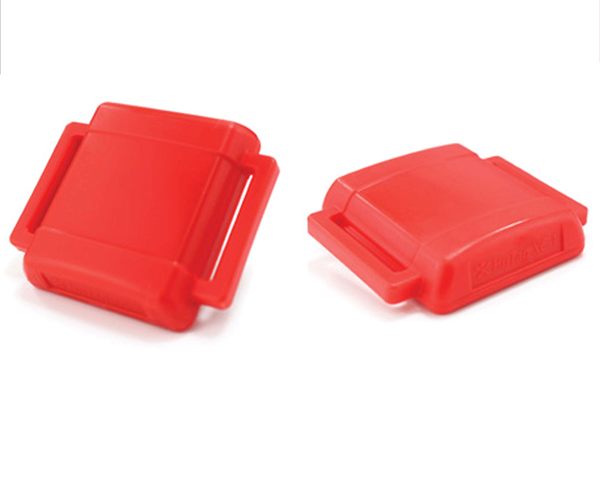
Passive UHF · reusable
A moulded tag that survives being handed out and collected back, event after event. The club option: no re-ordering, no encoding, nothing to run out of on a Sunday morning.
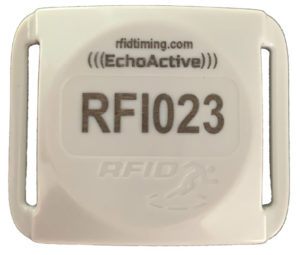
Active · 2.4 GHz
Sealed in polycarbonate, 15 g, asleep until the loop wakes it. It answers with a six character code, its own timestamp and its own diagnostics.
*Excludes local taxes and duties. Add 10% GST for Australian customers. Today's shop prices in Australian dollars. A neoprene ankle band to carry a tag is $3.25. Disposable chips start around 20c on the open market, and from us at volume, unencoded or printed.
The part that matters most
We would rather you sourced your own. Disposable chips start around 20c on the open market and most contract timers buy their own by the reel. Nothing in our boxes cares whose chip it is, and nothing is coded to lock you to us.
We encode and print to your race numbers when you would rather not handle it — that is a service, not a tie. It is why a club buys them from us and a contract timer usually does not, and both are right.
The saving is not that our chips are cheaper than somebody else's. It is that you are allowed to shop at all. On a locked system the chip is whatever the supplier says it is, at whatever the supplier charges, for as long as you own the reader.
Nine questions about what you are timing, and at the end you get the chips, the quantities and what it would cost.